GrowthForge™
Four Engines. One System. From Fragile to Scalable.
This page explains the architecture of GrowthForge™ — what each of the four engines does, why the sequence cannot be reversed, who the system is built for, and how the investment is structured.
If you would rather find out where your business currently sits before reading further, the diagnostic takes ten minutes. It will place you on the five-tier scale and tell you which engine to start with.
By the end of a GrowthForge™ program, every person on the leadership team can trace their daily behaviour to a KPI — that connects to a strategic priority — that connects to the founder's vision.
That is what alignment looks like when it is structural rather than aspirational.
GrowthForge™ is not a framework to be rolled out. It is not a coaching program. It is not a workshop series. It is a four-engine business transformation architecture — designed to run from operating stability at the foundation to deliberate strategic growth at the apex, in a specific sequence, for a specific reason
Why Businesses That Are Working Hard Are Still Not Compounding
The businesses that find GrowthForge™ are rarely failing. They are working hard, generating revenue, and moving forward. What they are not doing — and what is quietly costing them — is compounding. The effort they put in each week does not build cleanly on the week before. The decisions made in the planning retreat do not reliably change what happens on Monday morning. The culture conversations held in the leadership workshop do not hold under the pressure of a difficult quarter.
This is not a motivation problem. It is not a talent problem.
It is a sequencing problem. And it is invisible until it becomes catastrophic.
Peter Drucker observed that culture eats strategy for breakfast. The observation is almost universally quoted and almost universally ignored. Businesses invest heavily in strategy while the culture that will either carry or consume it is left to chance. Strategy consultants build plans on foundations they have not tested. Leadership coaches improve individuals inside organisations that are structurally unchanged. Workshop facilitators generate insight that evaporates because there is no embedding architecture to hold it.
The result is a familiar cycle: energy generated in a session, genuine agreement in the room, drift within six weeks, another session to regenerate the energy. The cycle continues not because the people are uncommitted — but because the system has no mechanism for making change permanent.
GrowthForge™ exists to break that cycle structurally, not inspirationally.
The Sequence Is the Methodology — Why the Order Cannot Be Reversed
The four GrowthForge™ engines are not a menu. A business cannot choose which engines to work and which to skip. The architecture of each engine depends on the one beneath it — and the consequences of ignoring that dependency are predictable.
A business that builds execution disciplines without first stabilising its foundational systems will create reliable chaos — the same dysfunction, repeated more efficiently.
A business that tries to build culture before its execution engine is working will find that cultural standards dissolve under the pressure of operational dysfunction — exactly as Drucker predicted. You cannot hold people to a cultural standard in a business where the operating systems are still founder-dependent.
A business that skips to TurboForge™ without the foundation of Stability, Execution, and Tempered Together will find that its strategy is consumed by the chaos beneath it. The turbocharger cannot amplify an engine that is not yet running well.
This sequencing principle is the most important thing to understand about GrowthForge™. It is not a philosophical preference. It is the structural reality of how organisations develop — and it is why the diagnostic exists: to determine where the current constraint actually is, so the work begins at the right engine rather than the most appealing one.
A business can operate in a state of quiet misalignment for years — working hard, staying cash positive, keeping clients happy — while the gap between what it could be and what it is quietly compounds.
GrowthForge™ exists to close that gap structurally, not inspirationally
Our Five Tier Scale - From Fragile to Scalaeble
Inside the Four Engines — What Each One Builds and Why It Stability comes first
Stability Engine™ — Control Before Ambition
The Stability Engine™ is the foundation everything else stands on. It answers one question, and it answers it before any other engine is allowed to begin: does this business have basic operating control?
Not impressive control. Not best-practice control. Basic control — the kind that means the owner knows their numbers, the right people make the right decisions, and the operating systems are reliable enough to be trusted.
Until that question can be answered with genuine confidence, all other investment in transformation is premature. A business that builds strategy on an unstable foundation is building on sand.
ValueForge™ establishes the financial literacy and operating visibility that every subsequent engine requires — using the Power of 1 financial model to show the compounding effect of small improvements across key financial levers.
HoleTruth™ is the systems-focused reality audit — it names what is actually happening in the operating systems of the business, without the filter of optimism or defensiveness.
KPIMaps™ at the Stability level builds the basic dashboard: not strategic yet, but clear enough to see.
LegacyLoops™ locks in the operating disciplines so that stability becomes permanent rather than episodic.
A business that completes the Stability Engine™ has something it may not have had before: an honest picture of where it actually is.
Execution Engine™ — Making Progress Repeatable
Most businesses have periods of strong execution — usually during crises, near deadlines, or when the founder is paying close attention. The Execution Engine™ is not concerned with peak performance moments. It is concerned with making strong performance the default — the thing that happens automatically, regardless of who is in the room.
The intellectual foundations of this engine are drawn from three of the most rigorously tested operational methodologies in business history: Toyota's 5S workplace organisation system, Goldratt's Theory of Constraints, and the evidence-based discipline literature. In the GrowthForge™ context, these are adapted for the SME environment — practical, facilitator-led, and embedded in the daily rhythm of the business.
PurgeAndPolish™ applies 5S discipline to eliminate the physical and operational clutter that slows flow and creates unnecessary cognitive load.
ThrottlePoint™ uses Goldratt's focusing steps to identify the single constraint limiting overall throughput — because improving everything simultaneously is the same as improving nothing.
KPIMaps™ at the Execution level builds process and departmental performance indicators.
LegacyLoops™ locks in the operational disciplines.
A business that reaches the end of the Execution Engine™ has something rare: it can make a promise and keep it. That is the platform from which deliberate growth becomes possible.
Tempered Together™ — Culture That Holds Under Pressure
The name is deliberately metallurgical. Tempering is the process of applying controlled heat to metal that has been hardened — it reduces brittleness and increases resilience under load. A tempered team holds its shape under pressure rather than shattering. That is the precise outcome this engine is designed to produce.
Culture is the most powerful force in any organisation, and the least managed. Most businesses have a culture — it developed by default through the behaviours of the founders and early leaders, through the decisions made under pressure, through who was rewarded and who was tolerated. The question is never whether a culture exists. The question is whether it is the culture that can carry the strategy.
CultureForge™ makes standards and behaviours explicit — defining the non-negotiables and building accountability into the standard rather than retrofitting it as a consequence.
CultureTrust™ draws on three of the most rigorous trust frameworks in the literature: Mayer, Davis & Schoorman's three-dimensional trust model (Ability, Benevolence, Integrity); Erin Meyer's Cultural Maps; and Stephen Covey's Speed of Trust — treating trust as a structural variable with a measurable economic cost, not a relational feeling.
RoleClarity™ closes the gap between what people think their role is and what others expect of it.
A-Grading™ builds the deliberate architecture for retaining and recruiting people who hold the standard.
Most organisations that stall between Developing and Structured are stalling here. The strategy is clear enough. The execution disciplines are improving. But the culture — the unwritten rules, the tolerance levels, the trust deficits — is the invisible ceiling. Tempered Together™ names it, measures it, and builds the architecture to raise it.
TurboForge™ — Deliberate Growth
A turbocharger is a precision engineering component that takes the energy already generated by the base engine — energy that would otherwise be partially wasted — and converts it into amplified output. It cannot function on an engine that is not already running well. It multiplies what is already there.
That is the exact function of TurboForge™: it takes the stability, execution capacity, and cultural architecture built in the three preceding engines and focuses it into deliberate, strategic growth. This is where the business stops managing its present and starts building its future.
FutureForge™ builds the compelling future state — a 10-year horizon and 3-year milestones that create strategic gravity.
ForgeMap™ turns that vision into a strategic architecture of priorities and resource focus — designed to be tested by real decisions, not filed as a document.
More Than Torque™ defines the specific winning play: the competitive advantage and strategic choices that make the business's success repeatable rather than accidental. Raw capability (torque) is necessary but never sufficient. This module names the right to win.
BreakPoint™ takes More Than Torque™'s output as its starting point and turns a searching question on the business itself: do we actually have the systemic capabilities required to execute this winning play? Where More Than Torque™ names the strategy, The Hole Truth™ (Strategic Edition) audits the capability gap between the strategy and the operating reality — identifying the structural, people, and process constraints that would prevent the strategy from being executed if left unaddressed. These findings become direct inputs to KPIMaps™ (Strategic Edition): the capability gaps are not just identified, they are measured, owned, and tracked until closed.
KPIMaps™ at the TurboForge™ level completes the cascade: every number traces back to a strategic priority, and every priority traces back to the vision.
LegacyLoops™ Strategic locks in the leadership behaviours that carry the strategy permanently — so the work does not require the next workshop to be sustained.
TurboForge™ does not produce a strategic plan. Plans are written and filed. Architecture is alive in the daily behaviour of the leadership team — and it is the daily behaviour, not the document, that determines whether the strategy actually holds.
The Tools That Run Through Every Engine — KPIMaps™, The Hole Truth™, and LegacyLoops™
Three tools in the GrowthForge™ system appear across multiple engines, each time at a higher level of sophistication. This is not repetition — it is a deliberate scaling architecture.
KPIMaps™ at the Stability Engine™ level: the basic operating dashboard — financial and operational visibility. Seeing clearly.
KPIMaps™ at the Execution Engine™ level: process and departmental KPIs — operational performance made measurable and accountable. Tracking reliably.
KPIMaps™ at the TurboForge™ level: the full strategic cascade — every number traces to a strategic priority, every priority traces to the vision. Every behaviour traces to a number.
A client who worked with KPIMaps™ at the Stability Engine™ level is not starting again when they encounter it at TurboForge™. They are ascending to the next resolution of the same framework, building on what they already understand.
The Hole Truth™ also scales across the system, but its question changes with each level.
The Hole Truth™ at the Stability Engine™ level asks: what is actually happening in the operating systems of this business right now? It is a ground-level reality audit — free of the optimism that typically filters the owner's view of their own systems. It names what is, not what should be.
BreakPoint™ is a strategic version of The Hole Truth™ and at the TurboForge™ level asks a harder question: does this business have the systemic capability to execute the winning play More Than Torque™ has just defined? The same unflinching honesty is applied, but now at the level of strategic execution — identifying the structural, people, and process gaps that stand between the strategy and its delivery. Those gaps feed directly into KPIMaps™ (Strategic Edition) as measured, owned items.
LegacyLoops™ is unique: it appears in all four engines. It is the universal embedding mechanism of the GrowthForge™ system — the architecture that converts insight into permanent behaviour at whatever level the business is working at. A business that only ever completes the Stability Engine™ still leaves with LegacyLoops™ running. A business that completes all four engines has LegacyLoops™ operating at every layer simultaneously.
A client does not finish KPIMaps™, The Hole Truth™, or LegacyLoops™. They deepen them. The system is designed to compound, not conclude.
Who GrowthForge™ Is For — and Who Is Not Yet Ready
GrowthForge™ is designed for business owners and senior leaders who have built something real and are now facing the complexity that comes with it. They are typically past the startup phase — the business has revenue, staff, clients, and structure — but the operating model has not kept pace with the scale. Strategy is often still in the founder's head. Culture is implicit. Execution is inconsistent. Growth, if it is happening, is driven by effort rather than architecture.
They are experiencing one or more of the following:
→ Working hard without compounding — effort that does not build on itself
→ Strategic clarity that evaporates between planning sessions
→ Culture conversations that do not change behaviour
→ KPIs that exist but are not connected to anything strategic
→ Growth that depends on the founder's energy and attention
These are not signs of failure. They are signs that the business has outgrown the way it is currently organised. GrowthForge™ is the system for that specific moment.
A note on readiness: GrowthForge™ is not appropriate for every business at every stage. A business in acute financial crisis needs stabilisation before transformation. A founder who is not prepared to face uncomfortable truths will not benefit from HoleTruth™. A leadership team that does not have basic psychological safety will struggle with CultureTrust™ before CultureForge™ has established the standards.
The diagnostic is partly a readiness assessment. Recommending the right starting point — even if it is outside the GrowthForge™ system entirely, even if it costs us the engagement — is an expression of the Nachas principle: the client's success is the goal, not the program fee. The diagnostic is honest because the work is honest.
The Investment Model — Why GrowthForge™ Is Structured as Upfront
Most consultancies bill monthly because monthly is what consultancies are comfortable with. GrowthForge™ does not, because monthly billing creates a relationship of monthly evaluation — and monthly evaluation makes it harder for the facilitator to challenge the client when the work requires it.
GrowthForge™ is structured as an upfront investment rather than a monthly retainer. This is a relational decision, not a financial one.
When a client has paid in full, both the client and the facilitator are fully committed. There is no monthly evaluation of whether to continue. That unconditional commitment creates the conditions for the facilitator to be genuinely direct — to challenge without softening, to name what is actually happening without the filter of commercial caution, and to hold the client to the standard the strategy requires. The Nachas principle — genuine investment in the client's success — requires a relationship that is not commercially conditional.
For eligible clients, approved financing is available through a broker for amounts up to $50,000 over terms of up to seven years. At typical program investment levels, the monthly repayment is comparable to common business software subscriptions — often less than what the business is already spending on tools that are not connected to any strategic architecture.
$20,000 program over 7 years: approximately $238/month
$30,000 program over 7 years: approximately $357/month
$45,000 program over 7 years: approximately $536/month
Figures are indicative only. Actual repayments depend on broker terms and client profile.
Both FutureForge™ and ForgeMap™ carry a standalone investment and are creditable against the full program if the client elects to continue within 90 days. This means the entry session — Forged in a Day™ — is a genuine commercial event, not a trial. A client who has committed financially to the entry session has already decided they are taking this seriously. That is the relational tone it sets.
The Full GrowthForge™ Journey
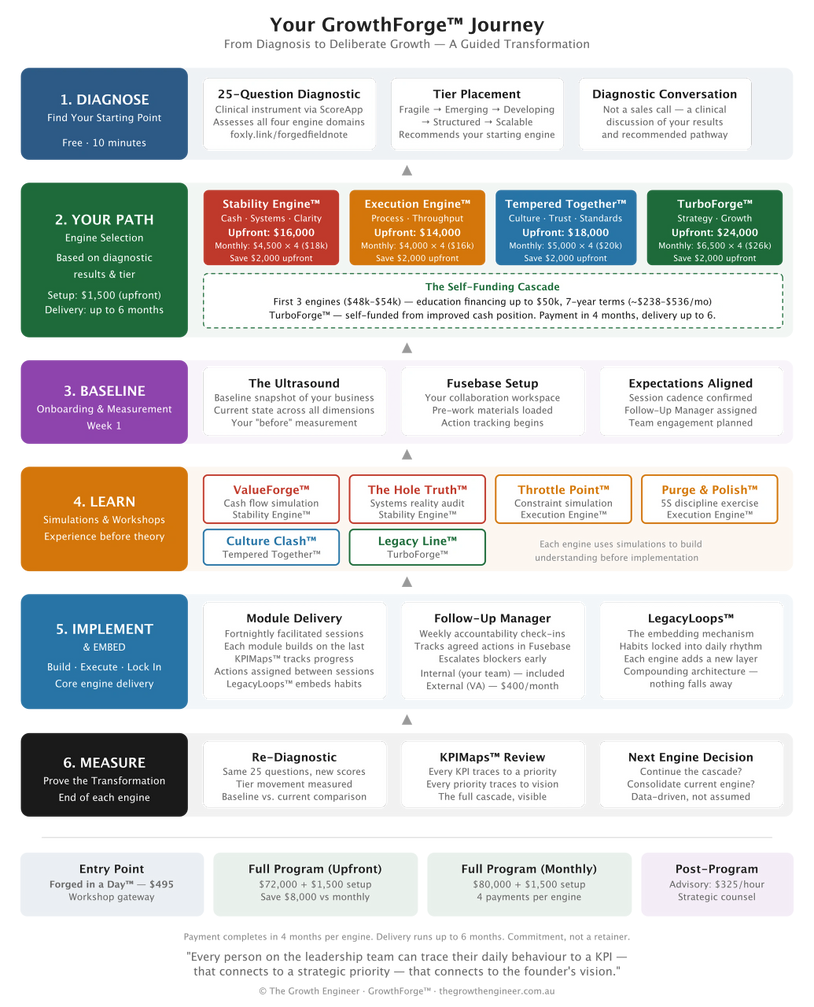
Two Entry Points. One Direction.
Every GrowthForge™ engagement begins with the same instrument: the 25-question diagnostic. The question is only whether you take it before or during a Forged in a Day™ session. Both paths lead to the same place — a named tier placement, a specific engine recommendation, and a clinical conversation about what the data is showing.
Path A — Take the GrowthForge™ Diagnostic First
Complete the 25-question clinical instrument online. You will receive a tier placement — Fragile through Scalable — and a recommended starting engine scored across all four engine domains. Charles reviews the results before the conversation. What follows is a diagnostic conversation: not a sales call, but a clinical review of what your data is showing and what it implies about where the work should start.
25 questions. Your tier. Your starting engine. No guesswork. Not a sales call — a clinical review.
Path B — Begin with Forged in a Day™
Forged in a Day™ is the commercial gateway to the GrowthForge™ journey. A four-hour public workshop — $495 per person — that runs three proprietary games across the Stability, Execution, and TurboForge™ engine domains before Charles introduces GrowthForge™ as a system. By the time you hear the name, you will have already felt two of its engines. That is not an accident. That is the design.
The morning closes with the 25-question GrowthForge™ diagnostic instrument, completed in the room. You leave with a named tier placement, a specific engine recommendation, and — if you choose it — an offer of a diagnostic conversation.
GrowthForge™ Does Not Produce Insights. It Produces Architecture.
GrowthForge™ does not produce insights. It produces architecture.
The difference is that architecture holds — it does not require the next workshop to be sustained. When the facilitator leaves, the system continues to run.
The Stability Engine™ gave the business operating control. The Execution Engine™ made performance reliable and repeatable. Tempered Together™ gave it a culture that holds under pressure. And TurboForge™ — the crucible at the apex of the system — converted all of that capacity into deliberate, measurable, strategically directed growth.
Each engine forged something that the next engine required. That is the architecture.
If the architecture above describes a business you are trying to build — or a business you suspect you have already outgrown — the diagnostic is the next step. Twenty-five questions, scored across all four engine domains. A tier placement. A recommended starting engine. And, if you choose it, a clinical conversation about what the data is showing.
Not a sales call. A diagnostic conversation.
This website uses cookies.
We use cookies to analyze website traffic and optimize your website experience. By accepting our use of cookies, your data will be aggregated with all other user data.